
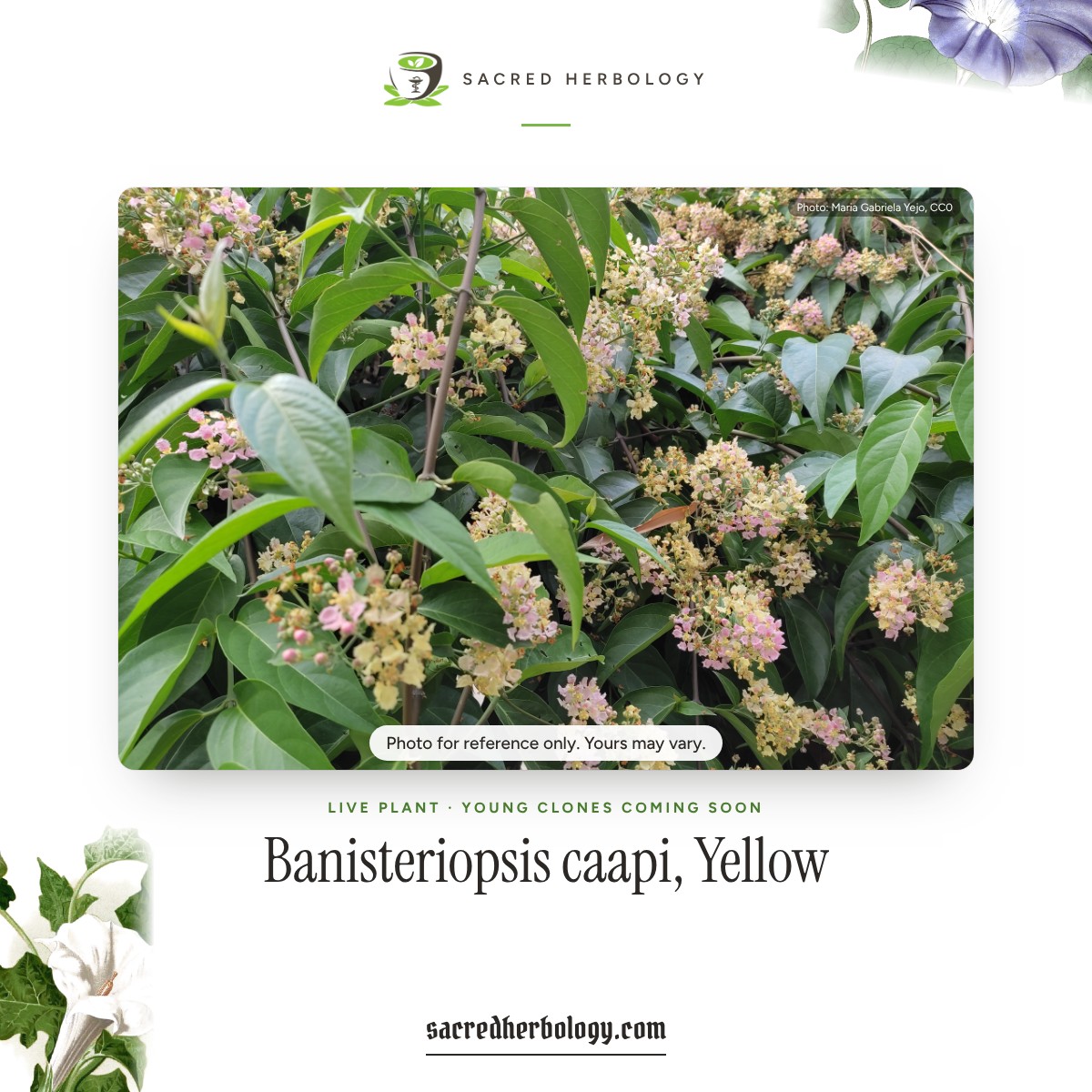
Banisteriopsis caapi (Spruce ex Griseb.) C.V.Morton, the Yellow clone. Live plant. Family: Malpighiaceae | Origin: Amazon Basin
The great woody liana of the Amazon, known across the western basin as ayahuasca, from the Quechua aya, spirit or the dead, and waska, vine or rope. Elsewhere it goes by yagé, caapi, mariri and other names. The English botanist Richard Spruce collected it on the Rio Uaupés in 1852 and saw it prepared by the Tukanoan peoples there; his notes were published after his death in Notes of a Botanist on the Amazon and Andes (1908), edited by Alfred Russel Wallace. Today it stands at the centre of Amazonian vegetalismo and of the Brazilian churches of Santo Daime and the União do Vegetal. We sell it with respect for those living traditions.
Growers in South America sort the vine into named types by the look of the stem and leaf. This clone goes by Yellow, the amarillo of Peruvian growers. In the garden it is a fast, twining climber with glossy paired leaves and loose clusters of small pink and pale yellow flowers on mature vines.
Grown by our own hands. Every plant in this listing is grown by the Sacred Herbology team. Frater Leo Viridis raises each one himself, from the mother plant and the cutting through rooting and potting to the day it leaves for the post. He feeds them well, and he tends them the way an esoterist tends anything given to the Work, with attention to the planetary hour, the Moon and the intention behind each cutting. That care goes into the pot with the plant.
What you receive: a young rooted clone, grown from a cutting of an established Yellow mother vine, in its pot, with this growing guide. Each clone is a natural cutting, so size and shape vary a little.
Sold for nursery, garden, collection and ritual display only. This vine is not sold for eating, drinking, brewing or extraction, and nothing on this page suggests you take any part of it internally. Rules on this species and its natural constituents differ between Australian states and territories and between countries. Please check the rules where you live before you order.
Growing guide
Climate and position
A tropical rainforest climber. It wants warmth, moisture and something to climb. Ideal growing temperatures sit between 20 and 32°C, and it sulks below 15°C. Frost kills it. Outdoors it suits frost-free tropical and subtropical gardens. Further south, grow it in a large pot in a warm glasshouse or a bright, sheltered corner that comes under cover in winter.
Light
Young clones like bright, filtered light. Once the vine has a few metres of growth it will take sun on its upper leaves while the base stays shaded, which is how it grows in the forest.
Support
Give it a trellis, a strong stake or a tree to climb from the start. The stems twine and harden into woody rope over the years, so put it somewhere you are happy to leave it.
Soil and watering
A rich, free-draining mix with plenty of organic matter. Keep it evenly moist through the warm months and let the top few centimetres dry out between waterings in winter. Wet, cold roots are the commonest way to lose a young clone.
Feeding
A balanced liquid fertiliser at half strength every two to four weeks from spring to autumn. A mulch of compost or leaf litter around the base keeps the roots cool and fed.
Propagation
Take semi-hardwood cuttings with two or three nodes in warm weather. Strike them in a moist, open mix under cover with bottom heat around 25°C. Roots usually show in four to eight weeks.
Common problems
Yellowing lower leaves in winter mean cold, wet roots. Move the pot somewhere warmer and water less. Leaf drop after the move from the box is shock and settles in a fortnight. Watch new growth for scale and mealybug, and wipe them off early.

Reviews
There are no reviews yet.